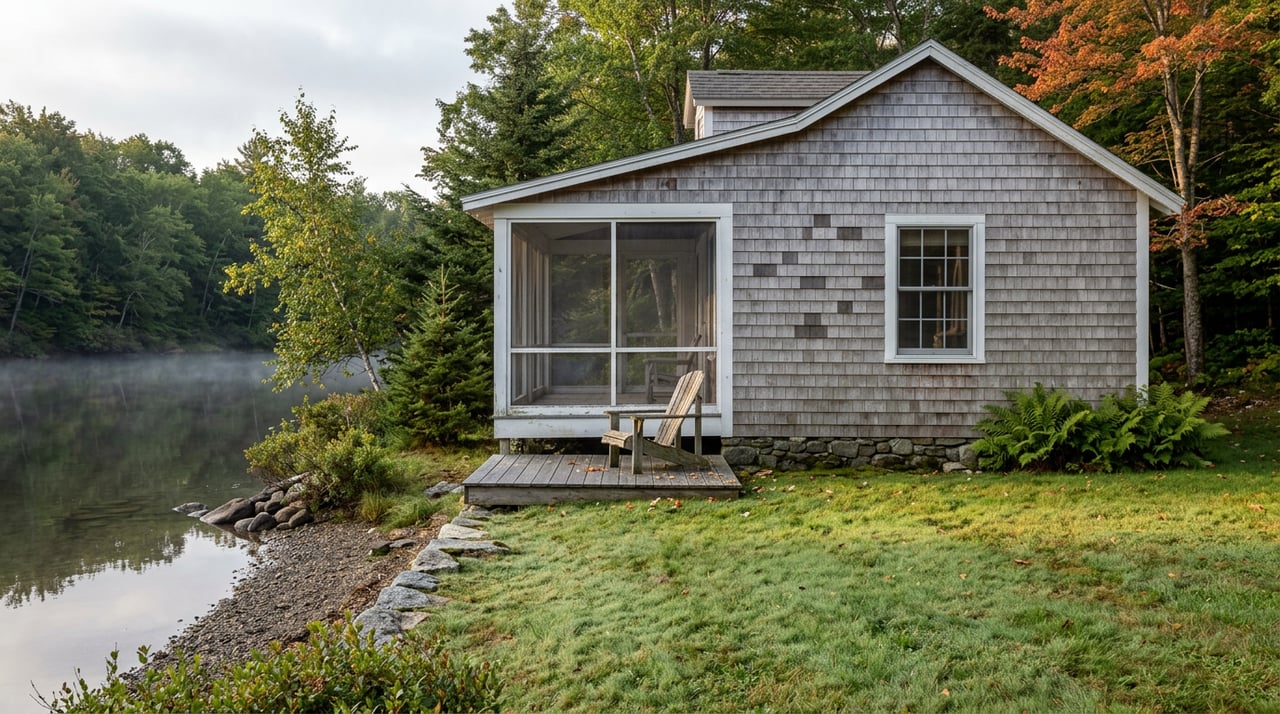
Two camps sit less than a quarter mile apart on the Saco River in Fryeburg. Same river frontage, same view of the far bank, same rough vintage of construction. One owner can add a screened porch toward the water next summer. The other cannot add so much as a foot of deck in that direction, ever, without tearing down and starting over. Nothing on either listing sheet tells you which is which. The difference lives in a setback line drawn decades before either camp was built for sale, and it is the single fact most waterfront sellers in Fryeburg do not think to mention until a buyer's attorney asks about it during due diligence.
That gap between what a listing shows and what the property can legally become is the real story behind Fryeburg's waterfront market right now. The median price is climbing. The days-on-market number is not falling to match. Both of those facts trace back to the same source: Maine's Mandatory Shoreland Zoning Act, and how it treats structures that were built before anyone thought to measure their distance from the water.
The Setback Line Nobody Puts on the Listing Sheet
Maine has required shoreland zoning statewide since 1971, and the rule that matters most to a buyer standing on a dock is the setback: how close a structure is allowed to sit to the water's edge. The commonly applied state standard sets that distance at 100 feet for structures on great ponds or on rivers that flow into great ponds, and 75 feet for other water bodies, streams, and wetlands.
| Water body type | Typical setback |
|---|---|
| Great ponds and rivers flowing into them | 100 feet |
| Other water bodies, streams, wetlands | 75 feet |
That framework touches Fryeburg's three defining waterways in different ways. The Saco River runs through the heart of town and feeds the region's canoe and tubing routes from Swan's Falls Campground down past Weston's Beach. Kimball Lake and Lovewell Pond bring their own setback math depending on how each is classified under the state's water body categories. Each parcel carries its own answer, and because shoreland zoning is written into state guidelines but administered and enforced town by town, the number that actually governs a specific lot is the one written into Fryeburg's own shoreland ordinance, not a number pulled from a statewide FAQ. The Maine Department of Environmental Protection is direct about this: local code enforcement is where a parcel's real answer lives.
Height and coverage rules stack on top of the setback. New or expanded structures generally cannot exceed 35 feet measured from the downhill side to the roof peak, and the first floor typically needs to sit at least one foot above the 100-year flood elevation. Then there is lot coverage: driveways, patios, decks, and the house itself are usually capped at 20 percent of the lot within the shoreland zone, because paved and roofed surfaces increase runoff into the water everyone bought the property to be near in the first place.
What "Nonconforming" Actually Means Once You Own the Camp
A large share of Fryeburg's older river and lake camps were built before their town's shoreland ordinance existed, or before the current setback was adopted. That makes them nonconforming: legally sited closer to the water than a new structure would be allowed to sit today. Nonconforming does not mean unusable. The state's own guidance on this point is plain: these structures may be repaired, renovated and maintained without a permit, provided no expansion occurs.
The trouble starts at that last clause. Expansion toward the water is off the table for a nonconforming structure, full stop, no matter how small. State shoreland amendments have pushed this further in many ordinances: expansion of any portion of a structure within 25 feet of the normal high-water line is prohibited outright, even if the addition would not move the structure any closer to nonconformity than it already is. Layered on top of that is the older 30 percent rule, where a "substantial expansion," meaning an increase of 30 percent or more in a structure's floor area or volume, can trigger a requirement that the entire structure meet the current setback rather than just the new piece.
Put together, this is what it means in practice for a Fryeburg camp built in the 1960s or 1970s that sits 40 feet from the Saco River instead of the 100 feet a new build would require today: the current owner can replace the roof, rewire the place, redo the kitchen, and keep using it exactly as it stands. What that owner cannot do is bump the footprint toward the river, add a garage that eats into the 20 percent lot coverage cap, or assume a buyer's dream addition is simply a matter of pulling a permit. A buyer who walks the property assuming those additions are routine is planning around a version of the house that does not legally exist.
The Camp-to-Year-Round Conversion Wrinkle
A common move among Fryeburg buyers is purchasing a seasonal camp with the intention of eventually living there full time, whether as a retirement plan or a slow transition out of a second-home routine. That conversion is allowed, but it is not automatic. Turning a seasonal camp into a permanent, year-round home typically requires a seasonal conversion permit from the local Plumbing Inspector, who has to confirm the subsurface wastewater disposal system, meaning the septic system, can actually handle the jump from occasional weekend use to daily year-round load.
For a buyer picturing weekends on Kimball Lake turning into full-time residence a few years down the road, that inspection is worth pricing into the offer before the ink dries, not after the moving truck arrives.
What This Actually Does to Fryeburg's Numbers
As of early August 2026, Fryeburg's median home sale price sits in the low $430,000s, up roughly 28 to 30 percent from a year earlier. Homes are also taking longer to sell than the national pace, generally in the 60s of days on market compared with a national average in the high 50s.
Rising prices paired with slower sales usually reads as a contradiction. Here it is not. Waterfront and near-waterfront parcels make up a meaningful share of what's for sale in a town wrapped around the Saco River, Kimball Lake, and Lovewell Pond, and every one of those transactions carries the extra step of confirming conforming status, checking lot coverage math, and in some cases waiting on a plumbing inspector's signoff before a lender or a buyer's attorney will move to closing. None of that shows up in a listing description. All of it shows up in the calendar.
There's a second force at work behind the price growth. Buyers who start their search on the busier New Hampshire side of the valley, around North Conway and Bartlett, routinely find themselves priced out or out of inventory during peak season and widen their search east across the state line into Fryeburg and its neighboring Maine towns. That steady overflow of demand, arriving on a market with a genuinely limited and partly nonconforming waterfront inventory, is a plausible piece of why Fryeburg's median has moved as sharply as it has this year.
Before You List or Make an Offer, Ask These Questions
- Is the structure currently conforming or nonconforming under Fryeburg's shoreland ordinance, and how close is it to the setback line?
- What is the parcel's current lot coverage percentage, and how much of the 20 percent allowance is already used?
- If a future owner wants to convert the property to year-round use, has the septic system been evaluated for that load?
- Were any past additions permitted, or were they built before the current ordinance and never reviewed?
- What is the property's elevation relative to the 100-year flood line, particularly for anything below the first floor?
Frequently Asked Questions
Does the setback rule apply the same way to the Saco River, Kimball Lake, and Lovewell Pond? The underlying state framework treats great ponds and rivers flowing into them under the 100-foot standard and other water bodies under the 75-foot standard, but each is subject to Fryeburg's own adopted ordinance, so the exact figure should be confirmed for the specific parcel with the town's code enforcement officer.
If a nonconforming camp is destroyed by fire or storm, can it be rebuilt? Rebuilding rules for nonconforming structures are set at the local level and often depend on the extent of the damage, so this is a question to bring directly to Fryeburg's code enforcement office before assuming a like-for-like rebuild is guaranteed.
Does nonconforming status make a property worth less? Not necessarily. Many buyers specifically want an older camp sited closer to the water than new construction would ever be allowed, and are willing to trade future expansion rights for that proximity today. What it does mean is that the trade should be priced and disclosed clearly, rather than discovered midway through a purchase agreement.
Waterfront property in Fryeburg rewards buyers and sellers who understand exactly what they're trading, not just what they're viewing from the dock. If you're weighing a sale on the Saco River, Kimball Lake, or Lovewell Pond, or trying to figure out what a specific parcel's setback and coverage numbers actually allow, Saco Valley Real Estate can walk the property with you and pull the town-specific answers before you list or make an offer.